Robert Antoshak
Managing Partner
Fiber markets, trade policy and sourcing strategy. More than three decades working across the textile and apparel supply chain.
We help textile and apparel companies evaluate investments, improve operating performance and develop sourcing strategies that hold up in practice. Gherzi Americas is part of the Gherzi organization, founded in Switzerland in 1929, with 120 consultants and 15 offices worldwide.
A free textile and apparel market dashboard: cotton and fiber prices, freight, currency, US apparel imports, tariffs and industry indicators, with sources and reporting periods.
Gherzi Perspectives articles and podcasts, and white papers including The Americas Textile and Apparel Complex, The Future of Denim and The Fiber Wars.
Robert Antoshak, Managing Partner: r.antoshak@gherzi.com
Americas · New York: David Uricoli, d.uricoli@gherzi.com · +1 646 918 4160
© 2026 Gherzi Americas
Textile & apparel consulting
We help textile and apparel companies evaluate investments, improve operating performance and develop sourcing strategies that hold up in practice.
The questions behind the work
Test the assumptions before committing capital.
↗02Understand where operations can deliver more.
↗03Assess the costs and risks behind your supply base.
↗04Determine what needs to change and what it will take.
↗
From assessment to implementation
A sourcing decision affects the mill. A machinery investment depends on the market. We bring technical and commercial experience to the same conversation, with specialists who understand how the pieces fit.
Explore how we help ↗The Americas team
Managing Partner
Fiber markets, trade policy and sourcing strategy. More than three decades working across the textile and apparel supply chain.

Partner
Business strategy and financial analysis, with experience spanning manufacturing, retail and investment banking.

Partner
ESG, social compliance and supply-chain diligence. More than 35 years working on responsible sourcing.
Research & commentary
Our consultants write about the industry they work in. Read their assessments of sourcing, manufacturing and the economics behind the headlines.
Read our latest thinking ↗Free industry resource
Fiber prices, trade flows and industry indicators, with units, sources and reporting periods beside each figure.
Explore the Market Dashboard ↗Start a conversation
Bring us the business question. We’ll help define the work needed to answer it.
Our services
From factory investments to sourcing reviews, we help clients assess their options and carry the work into operations. Each engagement starts with the business question you need answered.
Before committing capital, understand the commercial and operating assumptions behind the project.
Feasibility studies · Financial analysis · Acquisition and partner research
Depending on the engagement
Examine the constraints affecting output, quality and cost, then establish a practical improvement program.
Textile engineering · Mill feasibility studies · Plant planning · Operational benchmarking
Depending on the engagement
Evaluate where to buy, where to sell and how changes in trade affect your position.
Market research · Sourcing strategy · Nearshoring · Trade and tariff analysis · Brand development
Depending on the engagement
Establish what the evidence supports and where the business needs to improve.
Traceability · Environmental programs · Social compliance · UFLPA and forced-labor diligence · Circularity
Depending on the engagement
Getting started
The first conversation establishes the decision you need to make, the information available and the timing. A proposed engagement would then set out the scope, deliverables, fees and project responsibility.
Specialists join where the work requires them. Implementation support is defined as part of the agreed assignment.
Start a conversation
Bring us the business question. We’ll help define the work needed to answer it.
Our people
Our team brings experience from textile manufacturing, sourcing, finance and sustainability. We work with clients across the Americas, drawing on specialist expertise throughout the Gherzi organization.
Americas leadership
Managing Partner
Fiber markets, trade policy and sourcing strategy. More than three decades working across the textile and apparel supply chain.
Three decades across fiber markets, trade policy, sourcing, manufacturing, sustainability, traceability, and retail supply chains, helping companies manage sourcing risk and make better decisions in a volatile industry.
Robert P. Antoshak’s career has followed textiles from fiber markets into finished apparel, with trade policy running through much of that work. He has advised companies making sourcing decisions and represented industry interests in the negotiations that helped shape those decisions. That combination gives his industry commentary a grounding in both the rules governing trade and the work required to sell a product.
Antoshak began at the Fiber Economics Bureau in 1980, managing international research and publishing. He later established the international trade division at the American Fiber Manufacturers Association before moving to the American Textile Manufacturers Institute. Those Washington roles put him directly into bilateral and multilateral trade negotiations. His government advisory experience includes quota agreements and the development of trade arrangements involving NAFTA, the Multifiber Arrangement and the WTO.
He subsequently built businesses around trade analysis and market intelligence. After founding Trade Resources, he served as a vice president at Werner International, advising textile and apparel clients on market entry and operating performance. In 2001, he became president of Globecot, building the business from its start into multimillion-dollar sales. Following its acquisition, he managed commercial and operational functions for the fiber and textiles division at INTL FCStone.
His decade as managing director at Olah Inc. brought that market experience into cotton promotion and downstream textile development. He led consulting projects linking cotton interests with mills and apparel customers, including work on denim and sustainable sourcing. At Vidalia Mills, he helped develop the company’s marketing and communications around American-grown cotton and domestic denim manufacturing. These assignments required explaining a mill’s capabilities in terms that mattered to prospective buyers.
Later work with Gherzi and Grey Matter Concepts extended his involvement in manufacturing strategy and supplier development, with assignments ranging from investment feasibility and regional supply chains to sourcing men’s essentials. The common concern is whether a proposed strategy can work within the cost and production requirements of the business. His writing for industry publications, including just-style and Sourcing Journal, carries that concern into a broader public discussion.
With graduate study in history at Norwich University and undergraduate study in history and philosophy at Allegheny College, Antoshak also brings a longer perspective to industry change. His career spans the quota era and the sourcing systems that followed it. That history provides useful context when assessing how another change in trade policy may affect the people making and buying textiles.
Partner
Business strategy and financial analysis, with experience spanning manufacturing, retail and investment banking.
A global strategy and finance professional spanning manufacturing, retail, investment banking, and consulting, pairing financial discipline with practical operating experience to help companies improve performance.
Radhika Shrinivas has worked on textile growth from both the financial and operating sides of the business. Her experience includes evaluating manufacturing investments and managing the supply decisions that determine whether a product earns its expected margin. That range matters in an industry where a promising sales plan can become difficult to finance or execute once orders begin moving.
At Welspun, Shrinivas progressed through strategy roles in the managing director and chief executive’s office before becoming director of finance. She worked with senior management and the board on a multiyear $2 billion expansion strategy and evaluated more than $400 million in potential textile acquisitions. Her responsibilities included manufacturing assessments in the United States, India and Europe. She also helped digitize cost and production reporting, cutting the time required to close the monthly accounts by 40 percent.
Her subsequent role at Creative Home Ideas involved building the financial structure needed to support a home textiles business with more than $100 million in revenue. She led financial planning and cost control, negotiated a substantial credit facility and developed tools to assess how yarn and fiber prices affected product pricing. Those assignments brought financing decisions into direct contact with inventory and raw-material exposure.
From 2022 through April 2026, Shrinivas served as senior vice president of global supply chain, strategy and technology at Grey Matter Concepts. Her work included category expansion and the coordination of sourcing with retailer demand. The resulting commercial initiatives added $10 million in annual revenue, and changes in costing, pricing and supplier arrangements expanded margins by 6 percent. She also developed reporting that made inventory performance and production capacity more visible to management.
Shrinivas founded Threadpoint Advisors in May 2026 and joined Gherzi Americas as a partner in July. Her early advisory assignments include helping a home textiles client retain a $30 million customer while securing a 10 percent price increase to address margin pressure. Another involved a three-year growth plan supported by financial projections and capital expenditure requirements. These are specific business problems with consequences that extend well beyond a strategy presentation.
A Certified Management Accountant with an MBA in finance and operations, Shrinivas has also served on industry and corporate boards. Her background equips her to examine a growth proposal from the customer’s requirements through to its effect on cash and capacity. It is an approach shaped by responsibility for the numbers as well as the work behind them.
Partner
ESG, social compliance and supply-chain diligence. More than 35 years working on responsible sourcing.
More than 35 years in ESG, social compliance, due diligence, and responsible sourcing, building stronger programs that protect the environment and support workers across global supply chains.
David Uricoli came to human rights work through the business of making clothes. Before overseeing global human rights at Ralph Lauren, he worked in pre-production and sample-room management, followed by sourcing and product development. That experience gave him a practical understanding of the factories and commercial relationships that a responsible sourcing program has to address.
His career began at Winer Industries in Paterson, New Jersey, in 1984. At Ralph Lauren, he became senior director of global human rights in 2000 and vice president in 2013, serving in that position through 2020. Over those years, his responsibilities moved well beyond the quality and delivery of a garment to the conditions under which it was produced. The work took him into sourcing markets across Asia, the Americas and Europe.
Uricoli’s subsequent consulting assignments show how that experience applies further up the supply chain. With the Responsible Sourcing Network’s YESS initiative, he facilitated five working groups developing an industry program intended to eliminate cotton produced with forced labor from yarn supply chains. At Club Monaco, he developed and managed a supplier compliance and traceability program. An assignment with SHI International extended his work into sustainable procurement and vendor due diligence outside apparel.
He joined Gherzi in 2022, bringing this operating background to consulting work that includes manufacturing feasibility and sustainability. One assignment examined the proposed construction of a whole-garment knitting factory in the United States for Nest Evolution Labs. His Gherzi work has also included analysis of apparel tariffs and presentations on changing trade conditions, placing sourcing decisions within their wider commercial setting.
His education includes menswear design and marketing at the Fashion Institute of Technology and study of freedom of association and collective bargaining at Cornell’s School of Industrial and Labor Relations. He also serves on the executive advisory board of FIT’s International Trade and Marketing Department. Across those activities, Uricoli brings an understanding of how buying decisions reach the factory floor. For companies trying to make responsible sourcing part of daily operations, that connection is essential.

Partner · Gherzi Textile Organisation AG
Global manufacturing leadership, investment and business transformation.

Consultant
Denim industry expertise and founder of the Kingpins Show and Transformers Foundation.

Consultant
Global sourcing, manufacturing, product development and sustainable innovation.
A global sourcing and manufacturing executive in fiber, textiles, and apparel, leading products from concept to consumer with expertise in sustainable innovation, operational excellence, and regulatory compliance.
Moving a textile technology from one country to another involves much more than finding a mill with available capacity. The process has to be reproduced, suppliers need clear requirements, and the commercial team needs product when customers expect it. Courtney Caneer-Williams has worked directly on those problems, including bringing brrr° technology from Taiwan into production in North Carolina.
As vice president of operations and product planning at brrr° from January 2020 through April 2026, Caneer-Williams oversaw international sourcing and product development. Her responsibilities extended from masterbatch execution into knitted and woven textiles for apparel and interior applications. She managed budgets exceeding $12 million and led an international team of nine, achieving cost savings of more than 8 percent through supplier improvements and changes in operating processes.
The company’s international structure made coordination a substantial part of the job. Caneer-Williams reorganized operating procedures across the United States, Europe and Asia, using a projection model with teams in Taiwan and China to align raw-material availability with the sales pipeline. She also helped bring a collaboration with CiCLO to market. These assignments required material development to stay connected to purchasing and delivery commitments.
Her earlier work at Everest Textile USA combined American textile production with garment manufacturing in Haiti. She developed products to customer specifications and worked on full-package supply arrangements that generated approximately $4 million in annual revenue. Before that, she spent nearly five years with HerMin Textile and Weavism in Taiwan, working in woven-fabric development and marketing. An earlier consulting role in Ningbo involved building a network of more than 50 Chinese manufacturers.
That experience is supported by language skills and formal study of international trade. Caneer-Williams works in English, Mandarin Chinese, French and Spanish, and holds an MBA focused on international textile and garment trade policy from the Middlebury Institute of International Studies. She also holds a degree in clothing, textiles and design from the University of Idaho. Her professional activities include chairing AATCC’s RA112 Thermal committee, consistent with her work in temperature-regulating textiles.
Through K2K Industries and K2K Transportation, she now advises brands and manufacturers on sourcing and product development while maintaining an involvement in logistics. Her consulting includes circularity planning and helping manufacturers reach new customers. Having worked within Asian mills and American commercial organizations, she understands the coordination required between them. Her experience is especially useful when a product has moved beyond the sample stage and needs a dependable route into production.

Consultant
Fabric research, sourcing strategy and product innovation for apparel brands.
A fashion executive with more than 20 years leading fabric research and development, sourcing strategy, and product innovation for brands including Tommy Hilfiger, Ralph Lauren, Nautica, and Walmart, advising on product development from trends to tariffs.
A fabric can look right in a design meeting and still create problems months later. The price may be wrong, the minimum order too large, or the finished material unable to meet the required quality standard. Christine Tymkiw has spent her career working through those questions early enough to give a collection a better chance of reaching production as intended.
Her background includes fabric leadership positions at Tommy Hilfiger and Walmart, followed by work with Ralph Lauren and other major apparel businesses. At Tommy Hilfiger, where she worked from 1997 through 2010, her responsibilities grew from children’s fabrics across eight divisions to senior roles in women’s and men’s development. She worked with mills in Europe and Asia as well as domestic suppliers, carrying fabric concepts through costing and bulk delivery. An assignment with the European women’s division also required coordination between New York and Amsterdam.
At Walmart, the scale changed considerably. As director of raw materials across apparel divisions, Tymkiw coordinated core fabric purchases involving millions of yards. She brought the fabric team into earlier concept discussions and introduced earlier testing with overseas offices to identify quality problems before production. During the cotton pricing crisis, she researched futures and kept management informed, adding market context to decisions about fabric cost.
Her later roles continued to combine material knowledge with improvements in how teams worked together. At Nautica, she led fabric, trim and color for the men’s and women’s divisions and organized mill weeks that gave designers more direct access to suppliers. At One Jeanswear Group, she consolidated similar fabrics across brands to improve purchasing terms. At Maurices, she helped merchants gain earlier visibility into product styling and cost while developing processes that carried designs into bulk production.
Through Tymkiw Consulting, she has advised on fabric research, sustainability and development strategy. Her 2024–2025 project management assignment at Ralph Lauren involved establishing processes across major categories, from inception through bulk production and quality. Her work reflects a detailed understanding of the decisions hidden inside a finished garment. It also shows why fabric development belongs in the commercial discussion from the beginning, when there is still time to change a specification or choose a better source.

Consultant
Materials development, manufacturing and biodegradation research.
A textile and manufacturing consultant with more than 20 years across materials development, biodegradation R&D, and multi-country sourcing, advising brands including Under Armour, Adidas, Target, and Reebok on which manufacturing decisions actually carry consequence.
Colleen M. Ahalt-Eagle’s work often begins where a promising material meets the demands of production. A new yarn or finish still has to perform consistently, and a sustainability claim needs testing that addresses the conditions behind it. Her career combines hands-on material development with experience building the sourcing and testing arrangements needed to make those decisions.
At Target, where she served as global materials development manager, Ahalt-Eagle developed more than 200 piqué and fleece-equivalent fabric options through mills operating across five countries, a sourcing effort that delivered approximately $150 million in savings. The assignment required attention to equivalent quality across different production locations, a recurring concern in her later consulting work. A material specification is only useful if suppliers can reproduce it.
Her subsequent work moved further into performance materials. At Reebok, she developed technical fabrics and trims, including a cooling fabric based on a new yarn formulation and human testing protocols. She also worked with Huntsman on moisture-management chemistry. At HanesBrands, she founded a technical think tank that brought polymer chemistry and industrialization expertise into fabric development.
At Kathmandu in New Zealand, Ahalt-Eagle helped take Archroma’s Earth Colours dye technology from concept through product launch and negotiated a two-year exclusivity agreement for Australasia. She also secured $1.2 million in material cost savings through supplier negotiations. These projects joined material innovation with the purchasing and commercial arrangements necessary to bring it to market. The technical work and the business terms had to advance together.
She established CAE Sustainable Innovation in 2017 and later founded The Blue Lab, which developed material-testing methods in partnership with Under Armour. Her work there included designing equipment and protocols for investigating material behavior, with a particular interest in biodegradation. Through her consultancy, she has also assessed research operations for commercial readiness and advised clients on manufacturing decisions. Her clients range from major sportswear companies to smaller product businesses.
Ahalt-Eagle’s route into textiles included fine art, museum conservation work and technical training in welding. She holds a BFA from the Cleveland Institute of Art and an associate degree in textile development and marketing from FIT. That background helps explain the breadth of her practical work with physical materials. Across manufacturing and research assignments, she examines the details that determine whether an idea can survive repeated production and use.

Consultant
Manufacturing turnarounds, spinning, technical textiles and advanced polymers.
A manufacturing turnaround leader with more than 20 years in spinning, technical textiles, and advanced polymers, having grown a Thai mill from $10M to $150M and advising boards and private equity sponsors on operations, capital efficiency, and EU and US compliance.
Amrin Sachathep’s manufacturing experience was built over more than two decades at Atlantic Mills in Thailand. As managing director, he was responsible for global sales and mill operations, with technical product development also under his direction. During his tenure, annual sales grew from $10 million to more than $150 million, and the company came to employ more than 800 people.
The scale of that business gave Sachathep experience with the practical demands of serving international brands. Atlantic Mills operated through a network of 20 international offices and agents, while its manufacturing work included changes to raw-material sourcing and environmental management. His responsibilities required connecting customer expectations with the capabilities of the plant. They also placed workforce management alongside decisions about production and investment.
As a director of AMC Spinning from 2014 to 2023, he oversaw a yarn operation exceeding $60 million, with more than 500 employees. That work included global cotton procurement and the development of technical yarns, along with projects involving recycled garment feedstock and the commercialization of dual-core stretch technology. Together, those assignments gave him experience evaluating material innovation under the conditions of industrial production.
Sachathep also worked closer to the consumer through businesses he co-founded. Flying Horse, based in London, focused on premium denim and natural indigo applications. Boyish, based in Los Angeles, developed women’s apparel with an emphasis on lower-impact production. In Laos, he established East Indigo, an automated garment and laundry facility incorporating water recycling. These ventures extended his involvement from spinning and fabric production into garments and branded products.
His more recent consulting work addresses manufacturing turnarounds and restructuring across textiles, rubber polymers and other industrial businesses. His assignments have included reducing material waste and reviewing factory layouts, alongside financial and environmental assessments. Work with glove manufacturers also brought him into polymer development and production requirements beyond textiles. He combines that operating experience with engineering studies at Duke University and an executive MBA from Quantic.
Sachathep’s background is particularly relevant to manufacturers considering substantial changes to their plants or product mix. He has managed established operations while also financing and developing new businesses. That experience provides a basis for examining whether an investment can be manufactured consistently, sold to a defined customer and supported by the company’s finances. The question is concrete: what will it take to make the proposed business work on the factory floor?
Connected worldwide
Founded in Switzerland in 1929, Gherzi brings engineering and business consulting experience to the textile industry worldwide. Gherzi Americas connects regional clients with that broader network.
The project determines the expertise involved, from manufacturing and plant planning to commercial analysis and supply-chain diligence.
Explore Gherzi worldwide ↗Start a conversation
Bring us the business question. We’ll help define the work needed to answer it.
Sustainability & supply-chain diligence
We help textile and apparel companies assess environmental performance, examine supply-chain evidence and put practical improvements into operation. Recommendations account for cost, technical feasibility and customer requirements.

Start with the evidence
Can the information behind your product be verified? Review supplier records and gaps in the chain of evidence.
Which changes deserve priority? Examine energy, water and emissions in the context of the operation.
Where are the weaknesses in your sourcing program? Assess requirements and the evidence used to demonstrate compliance.
Can the proposed system work commercially? Consider material quality, recovery routes and end-market demand.
What the work produces
An assessment should identify the evidence gaps and establish priorities. The implementation plan needs to reflect the resources and operating constraints of the business.
A documented assessment of available information, limitations and areas requiring further investigation.
Recommended actions with the resources and technical work needed to evaluate them.
An agreed plan identifying who owns each action and how progress will be reviewed.
Start a conversation
Tell us about the customer requirement, operational issue or supply-chain question you need to address.
Research & commentary
Research and commentary from Gherzi Americas on the forces affecting textile and apparel companies. Written by people who work in the industry and have opinions about where it’s heading.
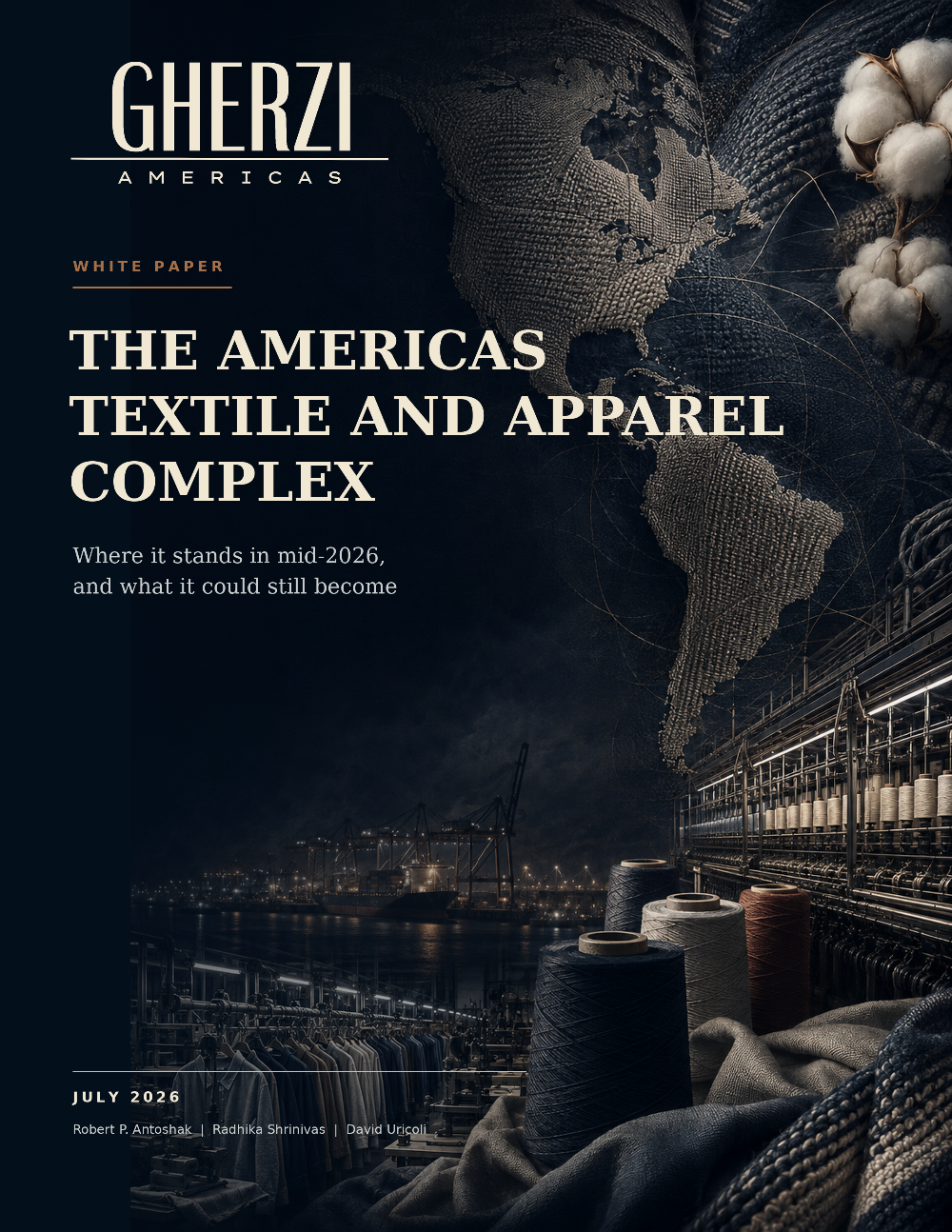

Where it stands in mid-2026, and what it could still become. A Gherzi Americas assessment of the Western Hemisphere supply chain, from fiber and trade policy to nearshoring and investment.
Your access is saved on this device. Choose where to save it, if your browser supports it.
Materials, markets, trade and the remaking of a global industry. How denim's fiber base, cost structure and trade routes are being redrawn, and what it costs to bet on the wrong one.
Your access is saved on this device. Choose where to save it, if your browser supports it.
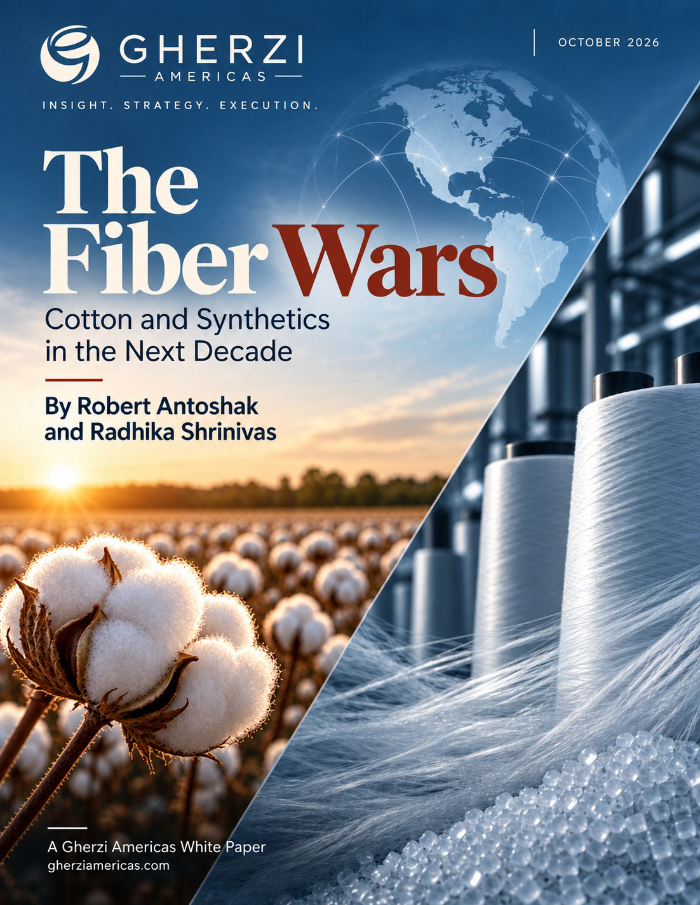
Cotton has spent twenty years losing a war it prefers to describe as a misunderstanding. A Gherzi Americas assessment of where cotton and polyester stand, what is shifting in trade, recycling and sourcing, and how the next decade could play out.
Your access is saved on this device. Choose where to save it, if your browser supports it.
Gherzi Perspectives collects first-hand reporting and analysis from Gherzi Americas consultants in the field. Views are the author's.
Start a conversation
Public commentary is a starting point. Talk to us about analysis tailored to your business.
Figures are indicative and provided for information only. They are not investment advice. Sources are listed with each figure. Currency rates refresh daily.
{{ mNudge }}
Talk to {{ mNudgeWho }} ↗Start a conversation
Discuss analysis for a sourcing review, market assessment or investment decision.
Market and currency data are indicative, may be delayed, and are not investment advice. See Terms of Use.
{{ mNote.body }}
Thank you. The weekly note will arrive in your inbox.
Figures are indicative and provided for information only. They are not investment advice. Sources are listed with each figure. Currency rates refresh daily.
{{ mNudge }}
Talk to {{ mNudgeWho }} ↗Start a conversation
Discuss analysis for a sourcing review, market assessment or investment decision.
Market and currency data are indicative, may be delayed, and are not investment advice. See Terms of Use.
Contact Gherzi Americas
You don’t need a finished project brief to get in touch. Tell us about the decision or problem you’re facing, and we’ll identify the right person to speak with.
Start a conversation
For a general project discussion, contact David Uricoli, Partner.
d.uricoli@gherzi.com ↗Your inquiry has reached the Americas team. We'll respond within two business days.
Who we are, what we do, and where we work. Our ten service areas and the team behind them, in eight pages.
Legal
Last updated: October 29, 2026
This policy explains how Gherzi Americas, a division of Gherzi Textile Organisation AG (“Gherzi”, “we”, “us”), collects and uses personal information through gherziamericas.com (the “Site”).
We do not sell or rent personal information, and we do not use it for automated decision-making.
Where data protection law such as the EU/UK GDPR, Swiss FADP or Brazil’s LGPD applies, we rely on your consent (analytics cookies, newsletter), our legitimate interest in responding to business inquiries, and steps taken at your request before entering into a contract.
We share information only with providers that help us run the Site: Hostinger (hosting), FormSubmit and EmailJS (form delivery and verification emails) and Google (analytics). Some providers process data in the United States or other countries. Where required, transfers are protected by appropriate safeguards such as standard contractual clauses. Information may also be shared within the Gherzi group to handle your inquiry.
The Site uses only the storage it needs to work (for example, remembering your language and report access) plus optional Google Analytics cookies, which are set only if you accept them. You can change your choice at any time through .
We keep inquiry and subscription data for as long as needed to respond and maintain the business relationship, and normally no longer than three years after our last contact. Analytics data is retained for 14 months.
Depending on where you live, you may have the right to access, correct, delete or export your personal information, to object to or restrict its use, to withdraw consent, and to complain to a data protection authority. California residents may request disclosure and deletion and will not be discriminated against for exercising these rights. To make a request, email d.uricoli@gherzi.com. You can unsubscribe from the weekly note at any time using the link in each email.
We use reasonable technical and organizational measures to protect personal information. No method of transmission over the internet is completely secure.
The Site is intended for business users and is not directed at children under 16.
We may update this policy. The date at the top shows when it was last revised.
Gherzi Americas, New York, NY, United States
d.uricoli@gherzi.com · +1 646 918 4160
Legal
Last updated: October 29, 2026
By using gherziamericas.com (the “Site”), operated by Gherzi Americas, a division of Gherzi Textile Organisation AG, you agree to these terms. If you do not agree, please do not use the Site.
Content on the Site, including reports, white papers, market data, podcasts and commentary, is provided for general information. It is not professional, financial, investment, legal or engineering advice and should not be relied on as a substitute for advice tailored to your situation. Engagements with Gherzi are governed by separate written agreements.
Prices, exchange rates and other market figures come from third-party sources, may be delayed or incomplete, and are shown as indicative only. We do not guarantee their accuracy and accept no liability for decisions based on them.
The Site and its content are owned by Gherzi or its licensors and protected by copyright and trademark law. You may view, download and print content for your own internal business use, provided you keep all copyright notices and credit Gherzi when quoting. You may not republish, sell, or systematically copy content without our written permission.
You agree not to misuse the Site, including attempting unauthorized access, interfering with its operation, scraping it at scale, or submitting false or unlawful information through its forms.
The Site may link to websites we do not control. We are not responsible for their content or practices.
The Site is provided “as is” and “as available” without warranties of any kind. To the fullest extent permitted by law, Gherzi is not liable for any indirect, incidental or consequential loss, or for loss of profit, data or business, arising from use of the Site or its content.
Our use of personal information is described in the Privacy Policy.
These terms are governed by the laws of the State of New York, United States, without regard to conflict-of-law rules. Disputes will be heard in the state or federal courts located in New York County, New York.
We may revise these terms at any time. Continued use of the Site after changes means you accept the revised terms.
Questions about these terms: d.uricoli@gherzi.com
We use optional analytics cookies to understand how this site is used. They are set only if you accept. See our Privacy Policy.